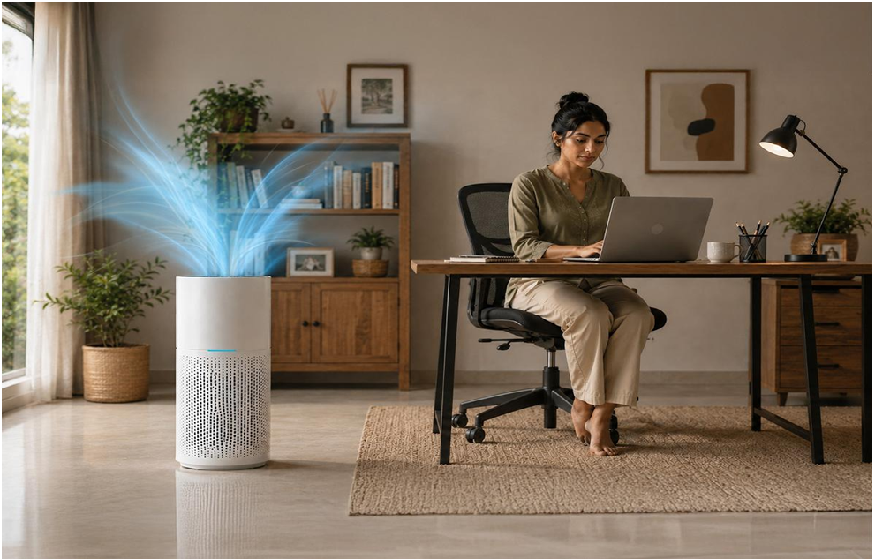
Buying an air purifier should be straightforward. In reality, the specification sheet often feels like it’s written for engineers instead of homeowners. Terms such as CADR, True HEPA H13, PM2.5 sensors, activated carbon filters and UV purification can make comparing models unnecessarily confusing. The good news is that each specification tells you something useful about how the purifier works.
Once you understand what these features actually do, choosing an air purifier becomes much less about technical jargon and much more about finding the right fit for your home. The air purifier price is important, but understanding the technology behind it is what helps you make an informed decision.
Understanding the Key Air Purifier Specifications
● Multi-Stage Filtration: Every Filter Has a Different Job
Many people assume every filter inside an air purifier performs the same function. In practice, each filter is designed to target a different type of indoor pollutant. This is why most air purifiers use a multi-stage filtration process instead of relying on a single filter.
– The pre-filter is the first stage of the system. It captures larger particles such as dust, hair and pet fur before they reach the finer filters. This prevents larger debris from accumulating on the primary filters too quickly.
– A True HEPA H13 filter captures fine airborne particles such as dust, pollen and PM2.5. These particles are small enough to remain suspended in indoor air, making them difficult to remove without fine-particle filtration.
- Activated Carbon Filtration: Activated carbon works differently from a HEPA filter. Instead of capturing particulate matter, it adsorbs odours, smoke and certain volatile organic compounds (VOCs). Using both filtration technologies together allows the purifier to address both airborne particles and gaseous pollutants.
● CADR (Clean Air Delivery Rate): This Isn’t Just a Quality Rating CADR (Clean Air Delivery Rate): This Isn’t Just a Quality Rating
CADR is probably one of the most misunderstood specifications. CADR simply tells you how quickly the air purifier can deliver cleaned air into a room. A larger living room naturally requires a different airflow from a compact bedroom.
Read More: Why a Water Softener for Home is Essential: Benefits of a Hard Water Softener
Choosing a purifier with a CADR that’s appropriate for the room size usually matters far more than simply choosing the highest number on the box.
●PM2.5 Sensors: These Tiny Numbers Matter More Than You Think
PM2.5 is another term that often appears on specification sheets. It refers to microscopic airborne particles that are small enough to remain suspended in the air for long periods and can easily be inhaled.
Many modern air purifiers include PM2.5 sensors that continuously monitor indoor air quality. If you’ve ever noticed an air purifier suddenly becoming louder without anyone touching it, this is usually why.
The sensors detect an increase in airborne particles and automatically increase the fan speed. Once the air becomes cleaner, the purifier slows itself down again. It’s a small feature, but one that allows the purifier to respond to changing air conditions throughout the day instead of operating at the same speed all the time.
Many systems also pair these sensors with colour-coded air quality indicators, making it easy to understand the condition of the air at a glance.
●Multiple Technologies: Combined Technology That Makes the Difference
No single technology solves every indoor air quality challenge. That’s why many modern air purification systems combine True HEPA H13 filtration, activated carbon filters, PM2.5 sensors, and intelligent airflow management into one multi-stage process.
Each stage performs a different role. Some capture particles. Some help reduce odours. Some continuously monitor the surrounding air and automatically adjust performance. The complete purification process depends on the product configuration, with each technology performing a different role.
Don’t Let the Specification Sheet Intimidate You
The purpose of a specification sheet isn’t to make buying an air purifier more complicated. It’s there to explain how the purifier cleans the air inside your home.
Once you understand what each technology contributes, comparing models becomes much easier. Instead of focusing only on the air purifier price, look at whether the purifier combines the features that are relevant to your home, whether that’s True HEPA H13 filtration, activated carbon filtration, PM2.5 monitoring, UV purification, air quality indicators or smart sensors that automatically adjust performance.
Read More: Thrilling Additions for Your Next Party
At the end of the day, the best air purifier isn’t the one with the longest list of specifications. It’s the one whose technologies match the way you live and the air quality challenges you deal with every day.
You May Like